


Who is Salih Acar? (1927 Plovdiv – 2001)
A Painter Who Interpreted Nature and Bird Imagery in Turkish Painting Within Thematic Continuity
His Life:
Salih Acar was born in Plovdiv in 1927. After completing his primary and secondary education there, he entered the Fresco Department of the Sofia Academy of Fine Arts in 1945 and studied there until 1950. This period enabled him to acquire an understanding of large-scale surface arrangement, mural painting techniques, and a consciousness of decorative composition at an early age.
In 1950, he came to Istanbul and enrolled in the Painting Department of the Academy of Fine Arts. During his education at the Academy, he did not limit himself to painting but also worked on sculptures for two years in Zühtü Müridoğlu’s studio. This experience contributed to the development of an artistic understanding that grasped the figure not only as a linear element but also with its volumetric and plastic values. After completing his education at the Academy, he devoted himself entirely to art production without undertaking any official duties. He became a member of the Turkish Painters Association and focused particularly on large panel paintings and decorative compositions. He created fresco paintings; he also worked in the fields of engraving and drawing. He won competitions for the Efes Hotel and the Tarabya Hotel, and applied frescoes and sgraffito to the walls of these buildings. In addition, he created murals for architectural structures in various major cities. Besides painting, he also experimented in sculpture. He held his first solo exhibition in 1955.
Artistic Perspective;
From Regional Figure to Decorative Surface (1955–1966)
Until 1966, the stylization of regional peasant figures is a defining trend in Salih Acar’s works. During this period, surface-based, decorative, and linear expression is prominent. Figures are treated more within the context of surface rhythm and compositional balance than through volumetric modeling. Scenes from rural life are conveyed with realistic observation, yet possess an illustrative clarity. Line is the fundamental constitutive element of the composition; Color is used as a measured element that supports the surface composition. Traces of the artist’s fresco background and experience with decorative wall painting are clearly visible in the works of this period.
Turning Towards Nature and Bird Series (Post-1966)
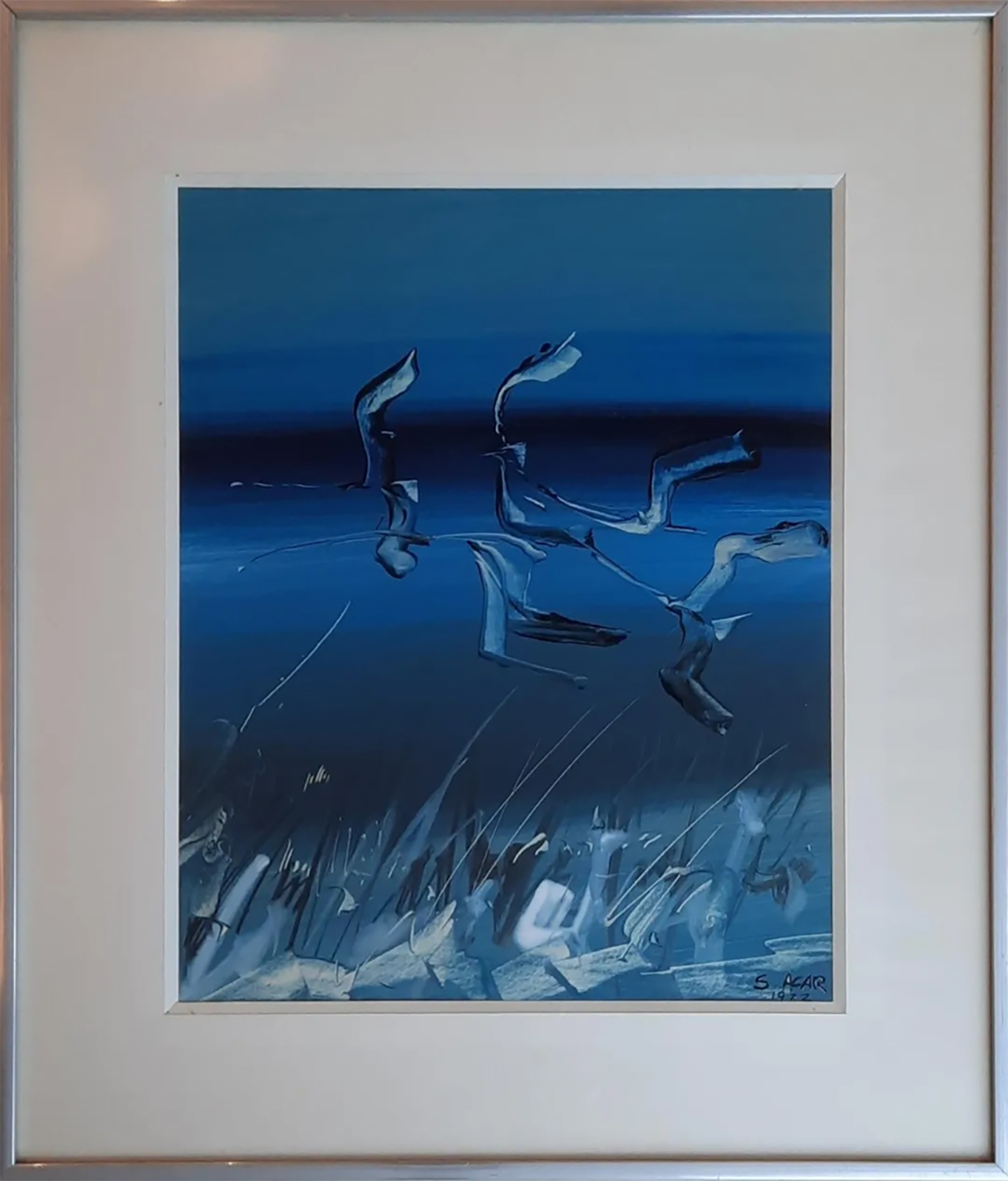
Salih Acar has been working on the subject of bird paintings, a theme rarely explored in contemporary Turkish art, for approximately twenty years. Applying the attention and meticulousness of the renowned bird painter John James Audubon (USA, 1780-1851) to his own birds, in his more fantastical paintings that rely more on paint than on graphic elements, Salih Acar's works reflect various bird species and are evaluated from the perspective of an abstract painting taste. A natural identification is established between the qualities specific to bird species and this kind of taste. In this respect, alongside Audubon's classical and naturalistic expression, Salih Acar's paintings are closer to the lines of modern painting. This warm and sincere closeness to nature stems from his childhood years spent in close contact with nature, and after participating in a duck hunt, the artist's love of nature was rekindled, leading him to take an interest in bird species. His work marking birds in the Manyas Bird Sanctuary opened up a wide horizon for him as a bird painter. Acar's bird paintings are the products of an artist who, while not deviating from real images around an unchanging theme, shapes those images according to his own understanding.
After 1966, the artist turned to systematically studying nature and researching his surroundings. From this date onwards, birds, seas, forests, fish, and living creatures in nature became the main themes in his paintings.
Acar, who closely observed many bird species such as wild ducks, cranes, storks, eagles, crows, and herons, created thematic periods in his art by dealing with these species in separate series. Each series is the product of an approach that includes both scientific attention and aesthetic interpretation.
The bird figures, while based on direct observation, are not merely naturalistic depictions. The artist rearranges the forms with an abstract aesthetic understanding while preserving the characteristic features of the species. Thus, he establishes a balance between the real image and the form-seeking of modern painting.
Nature Awareness and Environmental Sensitivity
Salih Acar's closeness to nature is not merely an aesthetic preference, but also a conscious environmental sensitivity. He participated in the work of the Turkish Nature Conservation Foundation as an artist; he strived to protect endangered bird species. He particularly drew public attention to the protection of the rapidly declining bald ibis in the Birecik region of Urfa; he was instrumental in making this issue a current environmental matter. In this respect, he established a direct link between artistic production and social responsibility.
His Position in Turkish Painting History;
Salih Acar is one of the few artists in contemporary Turkish painting who has dealt with the bird theme in a long-term and systematic manner.
The process extending from his early decorative and linear surface approach to his nature and bird-centered thematic production after 1966 shows a conscious shift in his art. His bird series create a unique pictorial language that combines both observational reality and modern abstraction tendencies. His awareness of surface elements stemming from the mural tradition, his emphasis on line, and the continuity in his nature-themed series place Salih Acar in a special position among artists with thematic unity in Turkish painting. His approach, which combines aesthetic production with environmental awareness, defines him not only as a painter but also as an artist who carries cultural and social responsibility.
-

- Salih Acar

-

- Salih Acar

-

- Salih Acar

-

- Salih Acar

-

- Salih Acar

-

- Salih Acar

-

- Salih Acar

-

- Salih Acar

-

- Salih Acar

-

- Salih Acar

-

- Salih Acar
-

- Salih Acar

-

- Salih Acar

-

- Salih Acar

-

- Salih Acar

-

- Salih Acar

-

- Salih Acar

-

- Salih Acar

-
- Salih Acar

-

- Salih Acar

-

- Salih Acar

-

- Salih Acar

-

- Salih Acar

-

- Salih Acar
