


Who was Prof. Dr. Özer Kabaş? (1934 – 1998)
Özer Kabaş is one of the most versatile artists in contemporary Turkish art, standing out as a painter, academic, designer, and art theorist. He contributed to the establishment of modern art education in Turkey and produced works in the fields of painting, printmaking, design, and art writing.
Life and Education:
Özer Kabaş was born in Mersin in 1934. He graduated from Robert College Engineering School (now Boğaziçi University) in 1957. Between 1957 and 1962, he studied at the Painting Department of the Faculty of Fine Arts at Yale University in the USA. Here, he became a student of important figures in modern art:
• Josef Albers
• Jack Tworkov
He held his first solo exhibition in the USA the year he graduated and returned to Turkey the same year. In 2008, the 10th anniversary of the artist’s death, a comprehensive retrospective exhibition was opened at the Yapı Kredi Kazım Taşkent Art Gallery, and a book about the artist was published.
Özer Kabaş passed away in Istanbul in 1998.
Academic Career and Educational Activities;
He was a faculty member at Robert College between 1964 and 1974.
He taught at Boğaziçi University from 1971 onwards.
He began teaching at Mimar Sinan Fine Arts University in 1983.
He became a professor in the Painting Department in 1990.
He served as the Head of the Painting Department in 1991.
The artist was among the influential academics in the development of the basic art education understanding in Turkey.
Design and Interdisciplinary Studies;
He founded the Urart Art Workshop with his siblings in 1971. Here, she pioneered work in the field of modern jewelry design and created one of the important examples of the art-design collaboration in Turkey.
Artistic Perspective;
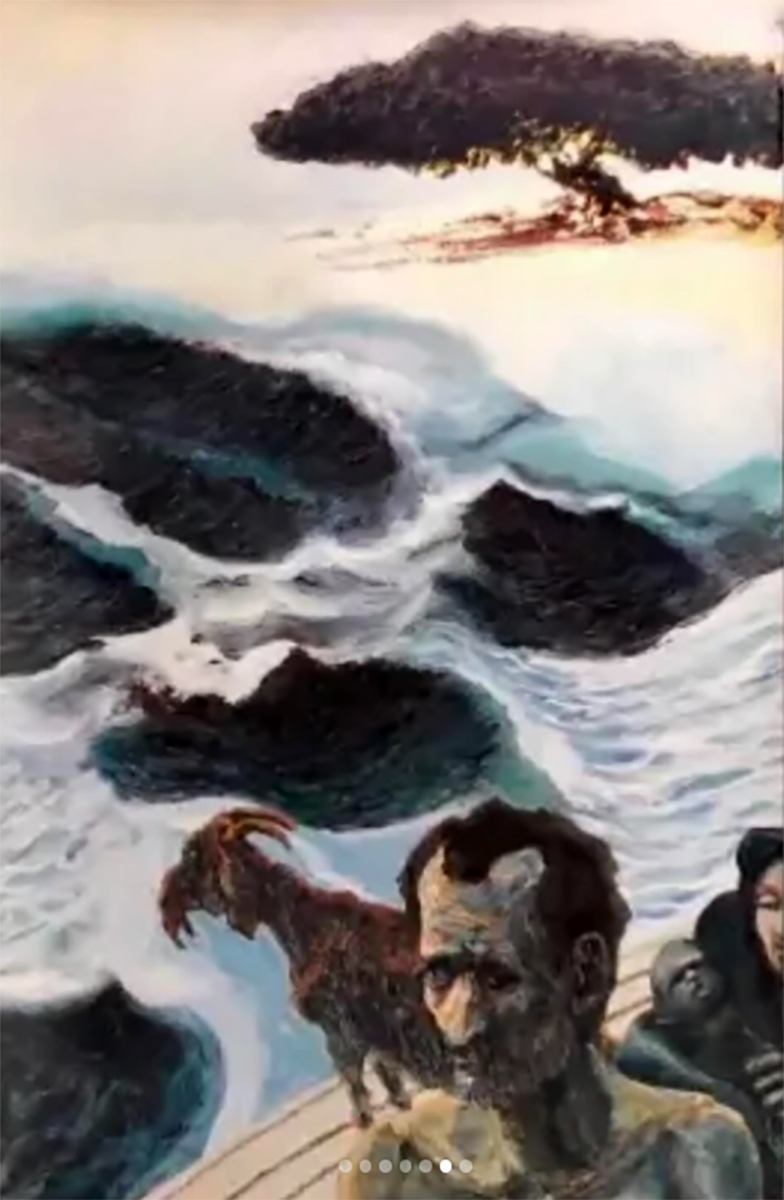
From 1975 onwards, sea and maritime themes predominated in her paintings. In her art:
• She dynamically addressed the relationship between drawing and paint.
• She increased the expressive power with figure deformation.
• She used socially relevant critical expression.
The artist's approach, summarizing her own understanding of art, is as follows:
“I used the variable, dynamic, and aesthetic elements in the drawing, application, and paint sequence to intensify figure deformation and expression. Carrying the drawing to the end of the painting does not diminish the importance of the drawing; on the contrary, it gains a contemporary vitality by combining with color and brush.”
Critic's Opinions and Thematic World;
Art writer Numan Serteli interprets Kabaş's painting world as follows:
The main setting in Kabaş's paintings is mostly the sea.
Wavy seas, boats, and people, animals, and elements of nature are all present together. Mother-baby figures symbolize the unbreakable bond between nature and humanity.
Personal Exhibitions:
• 1962 — Ross Talalay Gallery, New Haven (USA)
• 1965 — Turkish-German Cultural Center, Beyoğlu
• 1968 — City Gallery, Beyoğlu
• 1971 — Jewelry Exhibition, Hilton
• 1979 — Istanbul Art Festival, Aya Irini
• 1982 — Maçka Art Gallery
• 1987 — Maçka Art Gallery
• 1993 — Yapı Kredi Kazım Taşkent Art Gallery
• 1993 — Yapı Kredi İzmir Art Gallery
• 1998 — Yapı Kredi Kazım Taşkent Art Gallery
Awards:
• 1962 — Yale University Drawing Department Most Successful Student Award
• 1965 — TMTF International Culture Festival Engraving Category Best Turkish Artist (under 35 years old)
• 1967 — Hisar Short Film Competition First Prize (Istanbul Memory film)
• 1973 — Akbank Creative Power Encouragement Competition Jewelry Category Third Prize
• 1980 — Contemporary Istanbul Artists Exhibition Achievement Award
His Place in Turkish Art; Özer Kabaş:
• He contributed to the theoretical foundation of modern art education
• He is one of the important Turkish artists who produces interdisciplinary works
• He strongly combines his academic and artist identities
• He establishes an original narrative language through the theme of the sea.
-

- Özer Kabaş

-

- Özer Kabaş

-

- Özer Kabaş

-

- Özer Kabaş

-

- Özer Kabaş

-

- Özer Kabaş

-

- Özer Kabaş

-

- Özer Kabaş

-

- Özer Kabaş

-

- Özer Kabaş
-

- Özer Kabaş

-

- Özer Kabaş

-

- Özer Kabaş

-

- Özer Kabaş

-

- Özer Kabaş

-

- Özer Kabaş
