


Who Was Mehmet Nâzım? (1951–2018):
A Painter Shaped in Paris, Forging a Unique Visual Language Between East and West
Mehmet Nâzım was a Turkish painter born in Istanbul in 1951 who passed away in the Creuse region of France in 2018. The son of the poet Nâzım Hikmet and Münevver Andaç, the artist spent a significant portion of his life in France; he carved out a distinctive niche in contemporary Turkish painting through his unique figurative expression—developed particularly from the 1980s onwards—as well as his use of historical and cultural references, symbolic imagery, and bold colors.
For a long time, Mehmet Nâzım’s artistic identity remained overshadowed by the immensely powerful public and cultural persona of his father, Nâzım Hikmet. However, the recent resurgence of interest in his work—driven notably by the book *La Vie immédiate: Mehmet Nâzım* (which compiles his works from 1985–2000) and a comprehensive exhibition held at Ankara’s Galeri Siyah Beyaz in 2025—has paved the way for a re-evaluation of his place in contemporary Turkish art.
His Life;
Mehmet Nâzım was born in Istanbul in 1951 as the son of Nâzım Hikmet and Münevver Andaç. Reliable biographical sources on Nâzım Hikmet confirm that Mehmet was the son born of the poet’s relationship with Münevver Andaç.
Mehmet Nâzım’s childhood and youth were shaped not merely by an ordinary family environment, but by a milieu rich in literature, art, and intellectual discourse. His father’s extraordinary stature in Turkish and world literature, his mother Münevver Andaç’s connections within literary circles, and the artistic milieu he later encountered in France played a significant role in shaping his cultural world.
The artist lived in France from the 1970s onwards. Settling in Paris introduced him to a new environment—not only geographically but also artistically and intellectually. In the 1970s, Paris was a major hub where numerous Turkish artists lived, held exhibitions, and engaged with the international art scene; Mehmet Nâzım became part of this circle.
During his years in Paris, he forged relationships with artists such as Abidin Dino, Güzin Dino, Utku Varlık, and Faruk Sade, as well as others from various generations. According to the painter Utku Varlık, Mehmet Nâzım was not an artist who readily defined himself as a “painter.” He actually avoided drawing attention to his art, viewing his paintings largely as an extension of his own inner world. Nevertheless, those close to him would frequently find him painting in his studio.
This aspect points to a key feature of Mehmet Nâzım’s artistic persona: for him, art was not merely about gaining visibility or establishing a professional identity, but rather a way of constructing his own world. In the 1980s, the artist began to adopt a more consistent creative process. His friendship with Faruk Sade—founder of Galeri Siyah Beyaz in Ankara—marked a significant turning point during this period. Faruk Sade encouraged Mehmet Nâzım to exhibit his work and helped increase the artist's visibility in Türkiye. The “Kısas-ı Enbiya” exhibition, held at Ankara’s Galeri Siyah Beyaz in 1985, was one of the significant outcomes of this relationship.
Around 1988, Mehmet Nâzım left Paris with his mother, Münevver Andaç, and settled in the town of Cancale on the English Channel coast, where he established a home-studio. This change allowed him to move away from the bohemian and intense social atmosphere of Paris and transition to a more disciplined working life.
The Cancale period can be considered a crucial stage in the maturation of the artist's body of work. Here, he developed his reflections on the past, East-West relations, history, culture, and the human figure using a freer visual language.
Mehmet Nâzım passed away in France on October 15, 2018. While sources cite either Limoges or the Creuse region as the place of death, the biography provided by Galeri Siyah Beyaz specifies Creuse. Contemporary news reports also confirm that the artist was laid to rest in the vicinity of Guéret-Ajain, in the Creuse region of France.
Artistic Approach;
It is insufficient to define Mehmet Nâzım’s paintings merely as "figurative art." The artist’s figures are employed alongside symbols carrying historical and cultural connotations; rather than directly narrating a specific story, these elements often construct a visual world that is coded, multi-layered, and open to interpretation.
Particularly in the works produced between 1985 and 2000, one observes deliberate juxtapositions between Ottoman-Islamic culture, the Middle East, historical narratives, and modern life. However, this approach does not constitute a direct rendering of historical reality.
For instance, in the "Kısas-ı Enbiya" (Stories of the Prophets) series, figures and objects associated with the history of the prophets may appear in the same composition alongside modern elements such as automobiles or bicycles. Thus, instead of reproducing the historical narrative, the artist juxtaposes it with the contemporary world.
Consequently, the timeline in Mehmet Nâzım’s paintings is deliberately disrupted. Past and present, East and West, tradition and modernity converge upon the same pictorial surface.
This approach transforms the artist’s paintings into a realm of visual memory.
Themes and Technical Characteristics;
The Figure
The human figure is a fundamental element of Mehmet Nâzım’s paintings. However, the artist’s figures do not aim to convey anatomical realism in the academic sense.
Bodies are at times fragmented or enlarged, and specific limbs are deliberately emphasized. Elements such as hands, feet, and heads can acquire independent symbolic meanings within the composition.
Symbolic Language
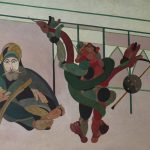
Objects such as the *kavuk* (traditional turban), staff, finger, star, and camel are not merely depicted items in the artist’s paintings; they are components of a visual language. The artist removes these symbols from their customary contexts and places them within new relationships.
History and Culture
Visual and intellectual associations with Ottoman-Islamic culture and Middle Eastern history constitute a significant portion of Mehmet Nâzım's work, particularly from the 1985–2000 period.
East-West Relationship
The artist's long years of living in France created a continuous encounter between East and West in his works.
In his paintings, the East is not used as an exotic backdrop; rather, it is part of the complex relationship the artist established between his personal cultural memory and the European society in which he lived.
Expressionist Figuration
Mehmet Nâzım's figures may be formally distorted, fragmented, or exaggerated; consequently, an expressionist tendency is evident in his work. The use of black ink in his drawings also makes the artist's hand movements and direct intervention visible.
Color
Color is not merely a complementary element of the composition. Throughout different periods, the artist has employed bold, intense fields of color to heighten the impact of his figures and symbols. For the comprehensive 2025 exhibition, a special display layout was designed based on the color palettes of the artworks.
Technique
Mehmet Nâzım's works feature techniques such as:
• Oil paint
• Acrylic
• Ink
• Ink on paper
• Oil on canvas
• Acrylic on canvas
Major Series and Works;
Kısas-ı Enbiya (Stories of the Prophets) – 1985
This is one of the artist's best-known series. It juxtaposes historical and religious narratives with imagery from contemporary life.
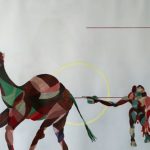
In this series, figures, symbols, and objects form new—and often complex—relationships rather than simply recounting traditional tales. The convergence of elements with vastly different connotations—such as a camel, a bicycle, and an automobile—within a single composition is a characteristic example of this approach.
Loncalar Geçerken (As the Guilds Pass By) – 1989
Historical figures and imagery evoking Ottoman culture take center stage in this series.
The artist's use of black ink is particularly striking. The figures—with their turbans, staffs, and bodies clad in curved boots—create the impression of a procession moving from the past into the present.
Oryantalistler / Les Orientalistes (The Orientalists) – 1993–1995
This is one of the artist's significant series in which he interrogates the cultural relationship between East and West.
Rather than viewing the concept of "Orientalism" solely as the way Westerners represent the East, it is possible to re-examine it through the intersection of the artist's own cultural background and his life in Europe.
Yıldızlar (Stars) – 1995
The "Stars" series (1995) marks another important stage in the artist's symbolic visual language. Here, the star motif transcends its role as a mere decorative element to become a key layer of meaning within the composition.
Muzaffer Rubens (Victorious Rubens) – 1997
Another facet of the artist's work was presented to the audience through the solo exhibition titled "Muzaffer Rubens," held at Galeri Siyah Beyaz in 1997. Solo Exhibitions
Mehmet Nâzım’s major, documented solo exhibitions are as follows:
• 1985 – “Kısas-ı Enbiya” (Stories of the Prophets), Galeri Siyah Beyaz, Ankara
• 1986 – “Confluences”, Paris
• 1988 – “Kısas-ı Enbiya”, Tem Galeri, Istanbul
• 1988 – “In Memory of Evliya Çelebi”, Maison des Travailleurs de Turquie, Paris
• 1989 – “Siyah Beyaz” (Black and White), Galeri Siyah Beyaz, Ankara
• 1990 – “Siyah Beyaz”, Galeri Nev, Istanbul
• 1993 – “Orientalistler I” (Orientalists I), Galeri Siyah Beyaz, Ankara
• 1995 – “Orientalistler II” (Orientalists II), Galeri Siyah Beyaz, Ankara
• 1995 – Urart Art Gallery, Istanbul
• 1997 – “Muzaffer Rubens”, Galeri Siyah Beyaz, Ankara
• 1998 – Urart Art Gallery, Istanbul
• 2000 – Galeri Siyah Beyaz, Ankara
In 2025, following the artist's passing, a comprehensive exhibition of Mehmet Nâzım’s work was held at Galeri Siyah Beyaz, bringing back into the spotlight pieces that had remained unseen for many years. The exhibition took place between January 24 and March 15, 2025, and showcased works from four of the artist's series spanning the 1985–2000 period. Notable Group Exhibitions
Among Mehmet Nâzım's notable group exhibitions are:
• 1976 – “7 Turkish Painters”, Vénissieux, France
• 1976 – “Hommage au Paysan de Paris”, Paris
• 1977 – “Turkish Painters”, Berlin
• 1977 – Art Festival, Istanbul
• 1978 – “Turkish Painters”, Tarbes, France
• 1979 – “In Memory of Yahya Kemal”, Closerie des Lilas, Paris
• 1980 – Galerie L'Oeil-de-Boeuf, Paris
• 1981 – “Confluences”, Paris
• 1982 – “Contemporary Turkish Painting”, Milan
• 1983 – “Figuration Critique”, Grand Palais, Paris
• 1985 – “Turkish Artists Exhibition”, Ville de Plessis-Robinson
• 1986 – “Turkish Artists”, F.I.A.P., Paris
• 1986 – “Le Droit d'Asile”, F.I.A.P., Paris
• 1987 – Kunstverein Melle, Germany
• 1987 – Museum Abtei Liesborn, Germany
• 1988 – “Highlights of Turkish Living Art”, The Hague
• 1989 – “5th Anniversary Exhibition”, Galeri Siyah Beyaz, Ankara
• 1990 – “Turkish Painters in Paris”, Centre Culturel Anatolie, Paris
• 1990 – “Paristanbul”, Cité Internationale des Arts, Paris
• 1991 – “210 Bd. Raspail”, Galeri Siyah Beyaz, Ankara
• 1992 – “210 Bd. Raspail”, Urart Art Gallery, Istanbul
• 1999 – “15th “Year Exhibition”, Galeri Siyah Beyaz, Ankara
• 2004 – Joint exhibition by Bihrat Mavitan, Ela Cindoruk, Mehmet Nâzım, and Yılmaz Aysan
The 2025 Mehmet Nâzım Exhibition and His Rediscovery;
The exhibition held at Galeri Siyah Beyaz in 2025 holds special significance for the re-evaluation of Mehmet Nâzım’s place in art history.
Works selected from the collection the artist had entrusted to Sera Sade were presented across four main series: *Kısas-ı Enbiya* (Stories of the Prophets), *Loncalar Geçerken* (As the Guilds Pass By), *Oryantalistler* (Orientalists), and *Yıldızlar* (Stars). Thus, the artist's creative trajectory spanning the years 1985–2000 could be viewed together in such a comprehensive manner for the first time.
The exhibition was accompanied by a publication titled *La Vie immédiate: Mehmet Nâzım*. Edited by Dr. Necmi Sönmez, this work examined the artist's output not only through visual material but also through a comprehensive chronology and previously published writings on art.
This development is significant for Mehmet Nâzım, as the fact that he was long evaluated through the identity of his father, Nâzım Hikmet, had overshadowed the independent examination of his own paintings. The 2025 exhibition and its accompanying publication marked a crucial step toward rectifying this oversight.
His Position in the History of Turkish Painting;
Mehmet Nâzım is a distinctive figure in contemporary Turkish painting who must be considered within the generation of Turkish artists living in France.
The most significant characteristic setting him apart is that he did not merely undergo a physical migration experience between Turkey and France; rather, he continuously juxtaposed these two cultural spheres within his paintings.
While the artist combines visual codes derived from Ottoman-Islamic culture with the modern and expressionist tools of Western art, he does not produce "Eastern" painting in a literal sense. On the contrary, by transporting images of the past into the contemporary world, he interrogates issues of time, culture, identity, and memory. Consequently, Mehmet Nâzım’s paintings construct a multi-layered narrative that embodies the contradictions of the modern world beneath imagery that might appear historical or exotic at first glance.
Furthermore, the fact that the artist kept his work in the background for a long time resulted in his art lacking sufficient visibility within the history of art. The exhibitions and publications of 2025 have significantly rectified this oversight, bringing Mehmet Nâzım back into the spotlight as an independent painter.
General Assessment:
Mehmet Nâzım (1951–2018) was a painter who spent the greater part of his life in France and distinguished himself in Turkish contemporary painting through a unique symbolic-figurative language.
While the fact that he was the son of Nâzım Hikmet is naturally a significant aspect of his biography, it is incorrect to define the artistic merit of Mehmet Nâzım solely through this familial connection.
Mehmet Nâzım’s true significance lies in his creation of an original visual language by juxtaposing his personal cultural memory with the modern European art scene. In series such as *Kısas-ı Enbiya* (Stories of the Prophets), *Loncalar Geçerken* (As the Guilds Pass By), *Oryantalistler* (Orientalists), and *Yıldızlar* (Stars), he consciously blends timeframes by combining historical imagery with elements of the contemporary world.
Symbolic elements—such as turbans, staffs, stars, hands, feet, and heads—combine with fragmented figures, bold colors, and the graphic quality of ink; this encourages the viewer to navigate through various layers of meaning rather than arriving at a single, definitive interpretation.
In this respect, Mehmet Nâzım’s painting can be viewed as a visual dialogue established between East and West, past and present, and individual and collective memory. The comprehensive 2025 exhibition—held years after the artist's death in 2018—and the publication *La Vie immédiate: Mehmet Nâzım* have made significant contributions to re-evaluating his place in art history. These endeavors demonstrate that Mehmet Nâzım should be regarded not merely as the son of a famous poet, but as an independent and original painter who created his own aesthetic world.
-

- Mehmet Nâzım

-

- Mehmet Nâzım

-

- Mehmet Nâzım

-
- Mehmet Nâzım

-

- Mehmet Nâzım

-

- Mehmet Nâzım

-

- Mehmet Nâzım

-

- Mehmet Nâzım

-

- Mehmet Nâzım

-

- Mehmet Nâzım

-

- Mehmet Nâzım

-

- Mehmet Nâzım

-
- Mehmet Nâzım
