

Who Was İbrahim Örs? (1946 – July 6, 2022)
A Painter Who Reconstructed the Figure through Abstraction, Deformation, and Critical Realism
His Life;
İbrahim Örs was born in 1946 in the Tercan district of Erzincan. His birthplace is also recorded as Tercan in the 1977 Istanbul State Academy of Fine Arts exhibition catalog held in the Mimar Sinan Fine Arts University archives. He spent his childhood in difficult economic circumstances. According to his daughter, Aslı Örs—speaking at the “Dünyanın Halleri” (States of the World) exhibition held in 2026—he was the son of a construction worker and one of seven children; after losing his father during his middle school years, he paused his education for a time to work on construction sites. During his university years, he supported himself by working in factories in Germany over the summer months. It can be argued that these experiences formed a significant background for the development of his later paintings, which explore the human condition and social life.
Entering the Istanbul State Academy of Fine Arts in 1965, Örs studied in Bedri Rahmi Eyüboğlu’s workshop. He did not merely study at the Academy; he also served as Bedri Rahmi Eyüboğlu’s assistant. This period, spanning 1965 to 1971, was a formative stage in shaping the artist’s approach to the figure, the pictorial surface, rhythm, color relationships, and traditional art sources. In the text for the retrospective exhibition prepared by IBB Culture in 2026, Örs is described as an artist trained as Bedri Rahmi’s student and assistant, and as one of the significant figurative painters of the “1968 generation” in Turkish painting.
Örs graduated from the Istanbul State Academy of Fine Arts in 1971. After graduating, he traveled to Scandinavia and worked at Jørgen Nash’s studio in Dragebyget, Sweden. This experience in 1971–1972 marked one of the artist’s first significant engagements with art circles outside Turkey. Beginning in 1972, he joined the faculty of the Istanbul State Academy of Fine Arts, where he taught until approximately 1985.
Having held exhibitions in both Turkey and Europe since the 1970s, Örs won major awards in various national art competitions. After leaving his position at the Academy, he spent a significant portion of his life between Denmark and Turkey. While Copenhagen became one of his primary creative hubs, he also forged a strong connection with the area surrounding the ancient city of Iasos—located in Kıyıkışlacık, within the Milas district of Muğla. He continued his painting practice in his studios in both Copenhagen and Iasos.
İbrahim Örs passed away in Copenhagen on July 6, 2022. Reports from the time indicated that he had been undergoing treatment for health issues for some time. His remains were subsequently brought to Turkey and laid to rest in Milas-Kıyıkışlacık, a place where he had spent part of his life over many years.
His works continued to be exhibited even after his death. The exhibition "İbrahim Örs: States of the World" (*Dünyanın Halleri*), held at Istanbul Metrohan from September 10 to December 1, 2026, brought together 62 works from the family collection that represented various periods of the artist's career. The exhibition stood out as one of the most remarkable retrospective-style presentations to date, offering an opportunity to re-evaluate the scope of Örs’s art.
Artistic Approach;
İbrahim Örs’s art can be regarded as a unique approach within Turkish painting that evolved in the transitional space between figurative expression and abstraction. For him, the human figure is not merely an anatomical image but a bearer of social, psychological, and plastic meanings.
Particularly in his early works, he focused on the overlooked details of social life, human relationships, and the contradictions of everyday existence. He treated the figure with deformations that at times leaned toward the humorous, the critical, or the grotesque. Consequently, his body of work has been associated in various sources with the concept of "critical realism."
However, Örs’s conception of realism is not based on copying nature exactly as it appears. The figure or object serves as the starting point of the composition; the artist deconstructs and transforms this visible reality, integrating it into his own formal order.
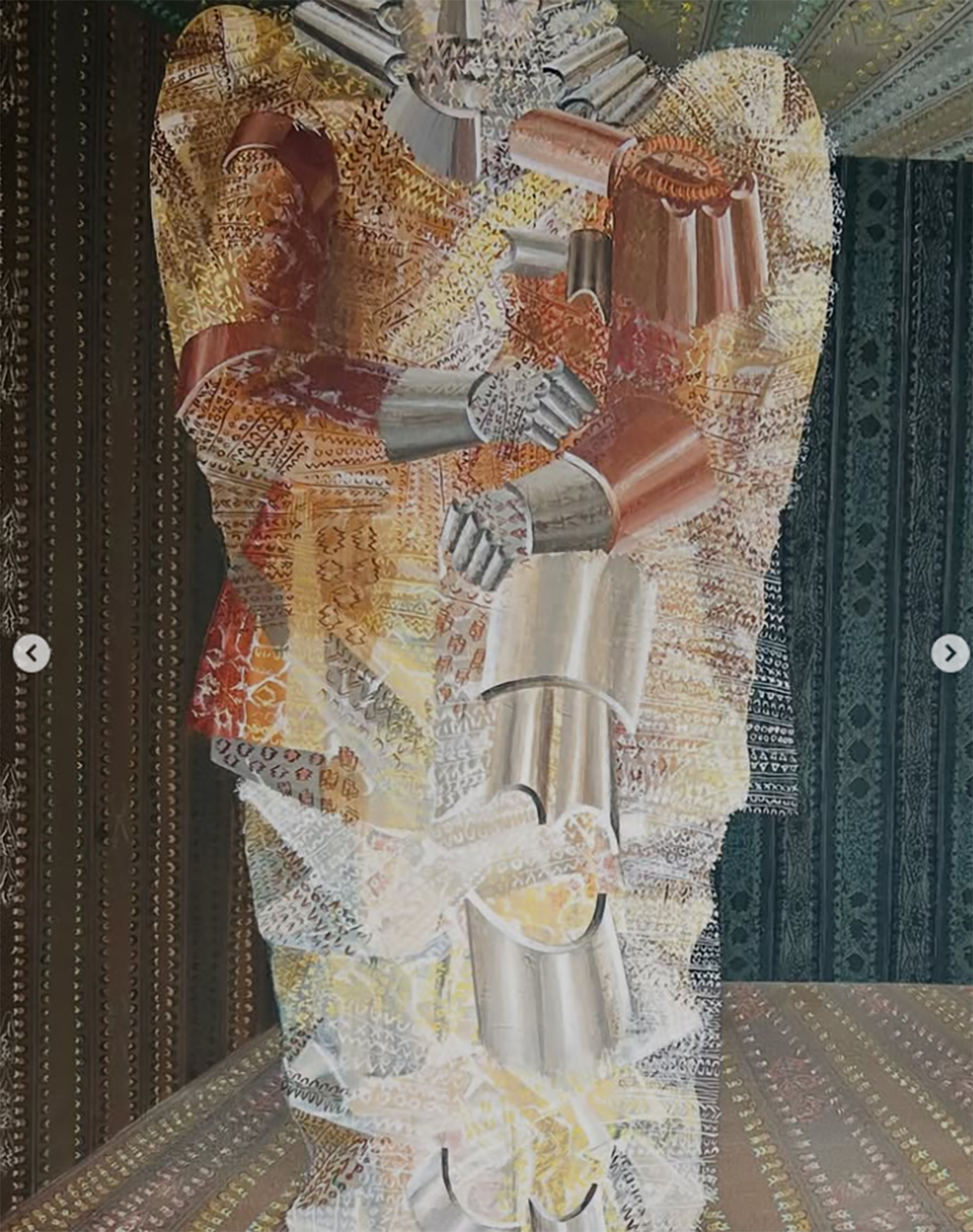
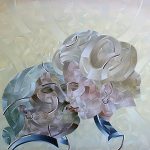
From the 1980s onwards, a tendency toward abstraction became increasingly pronounced in his work. Curvilinear shapes, repeating units, overlapping layers, and systematic deformations became the defining formal characteristics of Örs’s paintings. The text accompanying the IMM’s 2026 retrospective exhibition describes this shift as a more personal formal language developed by the artist starting in the 1980s.
For Örs, contrast is one of the most vital elements of painting. Relationships such as light-dark, figure-ground, volume-surface, warm-cool, and real-abstract generate the painting's dynamism. In the approach attributed to the artist, the painting is treated almost as a "play of contrasts"; the richness of contrasts within a composition enhances the painting's plastic value.
His refusal to completely break away from the figure is a significant outcome of this approach. Örs employed abstraction not as a means to destroy the figure, but to reconstruct it.
Themes and Technical Characteristics;
Human beings, animals, nature, and everyday objects constitute a broad subject matter in İbrahim Örs’s paintings. However, the artist’s primary concern lies not so much in *what* he depicts, but in how he transforms the world he sees into a visual system.
The works featured in the 2026 exhibition "Dünyanın Halleri" (States of the World) clearly demonstrate this diversity. The selection includes self-portraits and portraits of Bedri Rahmi Eyüboğlu, Bodil Örs, and Atatürk, alongside hands, feet, nude figures, horses, bulls, birds, trees, and various everyday objects.
The following stand out among the artist’s principal themes and formal characteristics:
• Human Figure and Portrait: Rather than directly depicting the human face and body, he expresses character and psychological state through formal deformations.
• Crowds and Social Life: He focuses on the relationship between the individual and society, particularly in his early works.
• Horse and Animal Figures: Horse heads, birds, bulls, and other animals are subjects the artist revisits repeatedly.
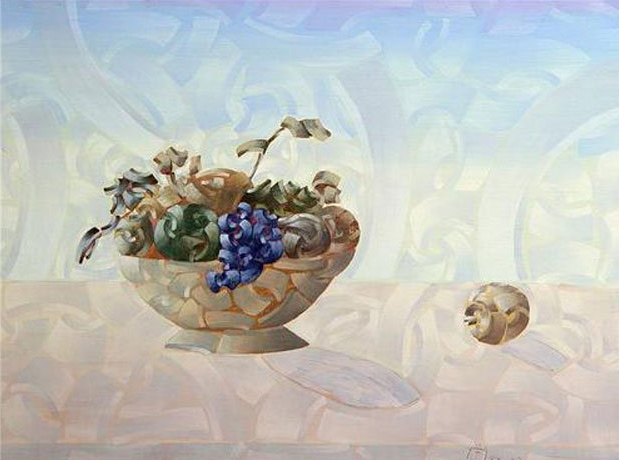
• Still Life: Fruits, flowers, and everyday objects transform into abstract formal arrangements while retaining their recognizability.
• Historical Portraits: Ottoman sultans and historical figures are reinterpreted within the artist’s contemporary formal language.
• Deformation: He creates a density of meaning by consciously altering the anatomical reality of the figure.
• Layering: He creates depth through methods that move beyond traditional perspective by superimposing forms. • Curvilinear Forms: Arc-like, circular, and swirling brushstrokes are among the artist's characteristic traits.
• Light-Dark Transitions: Tonal gradations create a sense of volume and space.
• Repetition and Rhythm: The sequential use of small formal units establishes a strong visual rhythm across the surface.
Consequently, while fragmented and interlocking forms are visible when Örs’s works are examined up close, the figure or object may reintegrate when viewed from a distance. This visual duality is a defining element of the artist's mature period.
Major Works and Series;
As İbrahim Örs was a highly prolific artist, a complete *catalogue raisonné* has not yet been published for public access. However, certain significant works and series can be identified based on records from museums, family collections, galleries, and auctions.
*Suleiman the Magnificent* (1999), an oil painting, is part of the Türkiye İş Bankası Painting and Sculpture Museum collection. The work is noted for the artist's combination of photorealistic elements with allusions to Pop Art.
*Still Life* (2001), another oil painting, is also held in the Türkiye İş Bankası Painting and Sculpture Museum collection. In this piece, the figurative image is fragmented and transformed into a rhythmic, layered surface.
Other notable works and series by the artist include:
• Self-Portrait
• Portrait of Bedri Rahmi Eyüboğlu
• Portrait of Bodil Örs
• Portrait of Atatürk
• Suleiman the Magnificent
• Murad I
• Still Lifes
• Horse Heads
• Bull Compositions
• Birds
• Hands and Feet
• Nude Figures
• Crowd Compositions
• Tree and Nature Studies
• The Two-Faced West
• He and Melek Hanım
Works such as *The Two-Faced West* and *He and Melek Hanım* are documented as powerful examples of the figurative distortion characteristic of the artist's later period.
Solo Exhibitions;
İbrahim Örs is known to have held numerous solo exhibitions, particularly in Turkey, Sweden, and Denmark. Some of the documented solo exhibitions include:
-1971-Jorn Nash Studio – Dragebyget, Sweden
-1972-Glostrup Kunstforening – Copenhagen, Denmark
-1972-Brøndby Kunstforening – Copenhagen, Denmark
-1982-Galata Art Gallery – Istanbul
-1983-Kibele Art Gallery – Ankara
-1984-Galeri Baraz – Istanbul
-1986-Rampelys Hall – Silkeborg, Denmark
-1987-Teşvikiye Art Gallery – Istanbul
-1990-Galeri BM – Istanbul
-1992-Kare Art Gallery – Istanbul
-1994-İş Bankası Parmakkapı Art Gallery – Istanbul
-1994-Kare Art Gallery – Istanbul
-1997-Kare Art Gallery – Istanbul
-1997-Turkuvaz Art Gallery – Istanbul
-1999-Arda Art Gallery – Ankara
-2000-PG Art – Istanbul
-2001-İş Bankası Parmakkapı Art Gallery – Istanbul
-2001-Arda Art Gallery – Ankara
-2001-Orkun Ozan Art Gallery – Istanbul
-2002-Bebek Art Gallery – Istanbul
-2003-DYO Art Gallery – Izmir
-2003/2004-Selçuk Yaşar Painting Museum and Art Gallery – Izmir
-2004-Artspace Gallery – Teşvikiye, Istanbul
-2005-PG Art – Istanbul
-2009-Nurol Art Gallery – Ankara
-2013-Art350 – Istanbul
-2014-Selçuk Yaşar Painting Museum and Art Gallery – İzmir
-2015- KAV Art Gallery – Ankara
-2017- Erinç Art – Istanbul
-2026- “İbrahim Örs: States of the World” (Dünyanın Halleri), Metrohan – Istanbul; a posthumous retrospective exhibition
Records from the Selçuk Yaşar Painting Museum also explicitly document that the artist held an exhibition at the museum between December 4, 2003, and January 3, 2004.
Notable Group Exhibitions and Art Events Participated In:
Örs participated in the State Painting and Sculpture Exhibitions, the Contemporary Artists Istanbul Exhibitions, events organized by the Visual Artists Association, and various juried exhibitions in Turkey. He also took part in group events held in Sweden, Denmark, Germany, Romania, and other European countries. An Academy catalog from 1977 notes that, by that time, he had participated in various exhibitions in Sweden, Copenhagen, Berlin, Romania, Istanbul, İzmir, and Ankara.
The artist's connection to the new figurative trends that emerged in the late 1960s and 1970s led to him being categorized within the "Generation of '68" in subsequent art-historical assessments. The 2026 IMM (Istanbul Metropolitan Municipality) retrospective also explicitly employs this generational classification.
Awards;
İbrahim Örs is one of the painters of his generation who gained the most visibility in competitions. As there are slight discrepancies regarding the years of certain awards across various sources, the chronology below has been prepared by cross-referencing different archives and biographical records.
• 1973 – Exhibition and competition organized by the Istanbul International Industry and Commerce Bank in honor of the founding of the Republic: First Prize
• 1974 – Artworks competition organized for the Istanbul Sheraton Hotel: First Prize
• 1976/1979 – State Painting and Sculpture Exhibition, Painting Achievement Award; sources differ on the year
• 1977 – Istanbul Archaeological Museums Open-Air Exhibition, Award
• 1978 – Visual Artists Association May Exhibition, Award; a photograph of Örs at the award ceremony is held in the SALT archive
• 1979 – Istanbul May 3rd Exhibition, Grand Prize
• 1981 – DYO “100th Anniversary of Atatürk’s Birth” Painting Competition, Award
• 1983/1984 – Contemporary Artists Istanbul Exhibition, Award; sources differ on the year
• 1984/1985 – ENKA Painting Competition, Second Prize
• 1988 – Mural (approx. 200 square meters) created for the Municipality of Copenhagen, Mural Award
• 1988 – Painting Competition in Memory of Mimar Sinan, First Prize
The SALT Research archive directly documents that Örs was an award-winning artist at the 1978 Visual Artists Association exhibition. Collections Containing His Works
İbrahim Örs’s works are distributed across institutional and private collections in Turkey and Europe. One of the most significant institutional collections—verifiable through publicly available sources—is the Türkiye İş Bankası Art Collection and the Türkiye İş Bankası Painting and Sculpture Museum.
The museum’s collection includes at least the following works by the artist:
*Kanuni Sultan Süleyman* (Suleiman the Magnificent), 1999, oil painting, 60 × 50 cm
*Natürmort* (Still Life), 2001, oil painting, 50 × 61 cm
Additionally, it has been announced that 62 works featured in the 2026 exhibition "Dünyanın Halleri" (States of the World)—held after the artist's death—are preserved in the İbrahim Örs family collection.
While it is known that his works exist in private collections in Turkey and Denmark, a complete, verified inventory of these collections is not yet publicly available.
Relationship with Bedri Rahmi Eyüboğlu
His relationship with Bedri Rahmi Eyüboğlu holds special significance for understanding İbrahim Örs’s artistic career.
Örs not only trained in the Bedri Rahmi Workshop but also worked as his mentor’s assistant. This experience enabled him to gain direct, hands-on knowledge of mural painting, mosaics, ceramics, and large-scale artistic projects.
According to accounts from that era cited in an academic study published by ITU, students and assistants undertook tasks on certain large-scale projects during Bedri Rahmi’s illness; İbrahim Örs was among those who worked in these teams.
However, it would be incorrect to view the art of Örs’s mature period merely as a continuation of Bedri Rahmi’s work. Over time, he transformed the sensibilities regarding color, surface, material, and local culture—which he had absorbed from Bedri Rahmi—into more radical deformations, layers, and a personal approach to the figure.
His Place in the History of Turkish Painting;
İbrahim Örs is a painter who must be considered within the context of the new figurative explorations that emerged in Turkish painting, particularly during the late 1960s and the 1970s.
Rather than directly perpetuating the classical academic approach to the figure, this generation re-examined the human subject within social, psychological, and critical contexts. In Örs’s paintings, the figure is never merely an aesthetic object; the human body and face transform into a plastic realm that expresses the contradictions of modern life, the individual's psychological state, and the artist's stance toward the world.
One of the most significant characteristics distinguishing Örs from many artists of his generation is that he does not view the figure and abstraction as opposing categories. He achieves abstraction by fragmenting, twisting, multiplying, and layering the figure; yet, the presence of the original human, animal, or object often remains palpable.
This characteristic becomes particularly pronounced in his post-1980 works. The pictorial surface is constructed almost as if by assembling small units of form. Traditional perspective gives way to a new concept of volume created through light-dark transitions, layering, and the repetition of forms.
Furthermore, his long artistic career, spanning both Turkey and Denmark, enabled Örs to synthesize local culture with the Western art tradition. He successfully merged the concepts of form and volume found in Renaissance and Baroque art with the figurative traditions of Turkish painting to create his own unique artistic language. The fact that the exhibition “Dünyanın Halleri” (States of the World)—organized by IBB Culture in 2026 and bringing together 62 works from the family collection—defines the artist as “one of the leading figurative painters of the 1968 generation in Turkish painting” further demonstrates that Örs’s place in art history is being articulated with increasing clarity in contemporary institutional assessments.
General Overview;
İbrahim Örs’s artistic career, spanning over half a century, offers a distinctive example through which one can trace the evolution of the figure in Turkish painting.
His artistic journey—which began during his Academy years as a student and assistant to Bedri Rahmi Eyüboğlu—is multifaceted, encompassing experiences in Sweden and Denmark, a tenure as a faculty member at the Istanbul State Academy of Fine Arts, successes in national competitions, and a long, productive period bridging Turkey and Denmark.
While he initially focused on the contradictions of social reality, the artist eventually arrived at a unique form of abstraction by deconstructing realistic imagery. Yet, he never completely abandoned the figure; the human face, the body, horses, bulls, birds, trees, or even ordinary still-life objects served as the starting points for formal exploration in his paintings.
Curvilinear lines, repetitive forms, deformation, the interplay of light and shadow, layering, and contrasts are the defining elements of his pictorial language.
For this reason, İbrahim Örs’s art cannot be categorized simply as either figurative or purely abstract painting. His true originality lies in his reconstruction of reality, taking the visible world as his point of departure.
The comprehensive exhibition titled "Dünyanın Halleri" (States of the World)—held at Metrohan in 2026, four years after his passing—provided a significant platform for re-evaluating, within the context of Turkish art history, the unique visual language he developed through his depictions of humans, nature, animals, and objects.
-

- İbrahim Örs

-

- İbrahim Örs

-

- İbrahim Örs

-

- İbrahim Örs

-
- İbrahim Örs

-

- İbrahim Örs

-

- İbrahim Örs

-

- İbrahim Örs

-

- İbrahim Örs

-

- İbrahim Örs

-

- İbrahim Örs

-

- İbrahim Örs

-

- İbrahim Örs

-

- İbrahim Örs
-

- İbrahim Örs

-

- İbrahim Örs

-

- İbrahim Örs

-

- İbrahim Örs

-

- İbrahim Örs
-

- İbrahim Örs

-

- İbrahim Örs

-
- İbrahim Örs

-

- İbrahim Örs

-

- İbrahim Örs
