


Habib Gerez (June 14, 1926 – May 25, 2022)
A Painter, Poet, and Man of Art Reaching from Galata to the World
His Life;
Habib Gerez—born Yusuf (Josef) Gerez—who holds a unique place in the landscape of Turkish painting, poetry, and culture, was born on June 14, 1926, in the Ortaköy district of Istanbul. His father, Sabetay Habib-Gerez, was engaged in the fabric trade, while his mother, Lüiza—a native of Eskişehir—played the oud and wove carpets. The fact that his mother elevated traditional carpet weaving beyond a mere craft by incorporating pictorial elements is a noteworthy aspect of the early connection Gerez formed with color and pattern in the art world.
Gerez spent his childhood in the vicinity of Ortaköy, home to a significant Jewish community during the 1920s and 1930s. He began his primary education at Ortaköy Primary School and later graduated from Kabataş High School in 1950. He went on to attend the Istanbul University Faculty of Law but was unable to complete his studies due to health issues. During his university years, he developed a keen interest in literature and poetry, establishing connections with the literary circles of the time.
In his youth, poetry was the art form that took precedence over painting in Gerez’s life. He published poetry collections during the 1950s and 1960s. Having been a student of Faruk Nafiz Çamlıbel at Kabataş High School played a pivotal role in establishing his ties to the literary world at an early age. During this period of poetic engagement, he frequented Istanbul’s literary and artistic circles, closely observing a cultural milieu that included figures such as Yahya Kemal and Attilâ İlhan. Regarding his art education, he did not strictly follow the path of formal academic art training. After graduating from law school, he attended the School of Applied Fine Arts as a guest student for a time. Later, he worked for approximately eleven years with Nurullah Berk, a prominent painter and academic of the era. In Gerez’s own words, this period of study marked a significant turning point in the evolution of his art.
The relationship he established with Nurullah Berk went beyond a mere technical teacher-student dynamic; while working in his studio near Tünel, Gerez created art in a studio neighboring Berk’s. During this same period, he also formed friendships with painters such as Şeref Akdik and İbrahim Safi. He also crossed paths with Bedri Rahmi Eyüboğlu within the art circles of the Galata and Asmalımescit districts. The fact that Bedri Rahmi admired Gerez’s work and encouraged him holds a significant place in Gerez’s memoirs.
Another important role in Gerez’s life was serving as the chief of staff to Chief Rabbi David Asseo between 1961 and 1996. Through this position, he gained intimate insight into the social and cultural life of the Turkish Jewish community. Alongside his identity as an artist, he amassed an extensive archive of photographs, documents, and publications that documented collective memory.
Over time, Galata became the focal point of Gerez’s life. For him, Galata was not merely a neighborhood where he resided, but a primary source of inspiration for both his art and his poetry. The three-story building in Galata, which he had restored in 1999, served as a living space, a studio, and an art house. Its walls displayed hundreds of artworks, while its archives housed thousands of documents related to his artistic career. In a 2008 interview, he recounted that 110 paintings hung in his home, approximately 4,000 were kept in storage, and he had created around 10,000 paintings over the course of his life.
The artist’s home in Galata was subsequently designated as a museum. Starting in 2014, Habib Gerez’s home and studio began serving as a branch of the Quincentennial Foundation Museum of Turkish Jews. In this way, efforts were made to preserve not only the artist’s works but also documents, books, photographs, and personal belongings related to his life for future generations.
Gerez’s artistic career is also notable for its extraordinary productivity. While the reported number of solo exhibitions varies across biographies published at different times, sources released after his death state that he held 142 solo exhibitions, 33 of which took place abroad. It is also recorded that he received a total of 63 awards in competitions for painting and poetry.
Gerez continued his creative output throughout the later stages of his artistic career. Poetry, painting, art criticism, and cultural activities became an inseparable whole. More than 600 of his articles were published in various newspapers and magazines, and he compiled his thoughts on art in books such as *Yaşamın Tadı Tuzu Sanat* (Art: The Spice of Life) and *Rüzgâra Söylenenler* (Things Said to the Wind).
Habib Gerez passed away in Istanbul on May 25, 2022, at the age of 95. Although some news reports cited May 26 as the date of his death, the date May 25, 2022, is used in *Şalom* magazine and in academic studies concerning the Turkish-Jewish press.
Artistic Approach;
One of the key elements in understanding Habib Gerez’s painting lies in the four distinct periods of his work, as defined by the artist himself.
In the 1960s, Gerez worked by thinning his paints with thinner and allowing them to flow across the surface, thereby creating images reminiscent of marbling. This initial period marked a process in which the artist moved beyond the classical approach to painting, utilizing paint materials experimentally on the canvas. The flow and intermingling of colors prioritized the aesthetic impact of the surface itself over the painting's subject matter.
In his second period, which began in 1970, the artist shifted toward a more realistic and concrete style. Trees, nature, the sea, cityscapes, and various figurative elements became more prominent during this time, though traces of the abstract fluidity from the previous period did not vanish entirely. Gerez himself described this phase as a transition from the abstract to the concrete.
The third period commenced in 1985. At this stage, Gerez created a new synthesis by bringing together his earlier abstract and realistic works. Consequently, his paintings from 1985 onwards are neither purely abstract nor realistic in the traditional sense; while forms remain distinct, the flowing paint, color transitions, and free brushwork on the surface imbue the paintings with an abstract character.
The artist’s fourth period, beginning in 2001, was defined by works he titled "Human Landscapes" (*İnsan Manzaraları*). Transforming his earlier abstract paintings into figurative compositions, Gerez brought together humans, animals, and dolls within a shared visual realm. Thus, the figures emerging from the abstract surface evolved from being direct portraits of real-world individuals into symbolic entities representing the human condition. These four periods are not separated by sharp boundaries. On the contrary, in Gerez’s art, one observes that earlier periods continue to live on within later ones. While the paint flows characteristic of the abstract period persist on the surfaces of his realistic paintings, images of trees, people, animals, and nature—derived from the realistic period—re-emerge in his subsequent abstract compositions.
Therefore, it is insufficient to define Habib Gerez’s painting using only a single concept such as “abstract,” “figurative,” or “impressionist.” His originality stems from his ability to synthesize these diverse approaches into a unique personal style over the course of a long artistic career.
Themes and Technical Characteristics
One of the most prominent themes in Habib Gerez’s paintings is Istanbul, and specifically the Galata district.
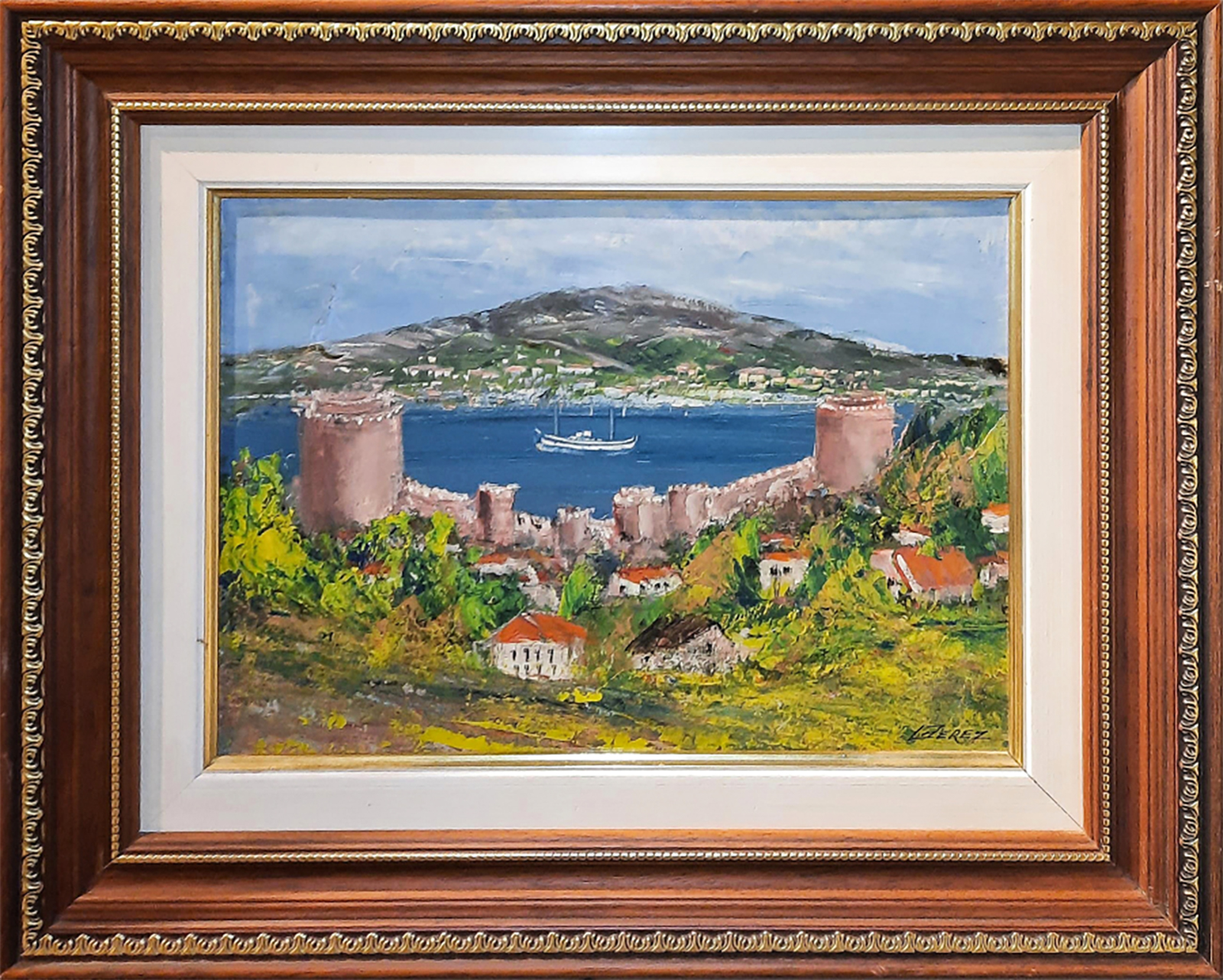
The Galata Tower, the streets of old Istanbul, the sea, the coastline, boats, and cityscapes appear in various forms throughout the artist’s work. For Gerez, Galata is not merely a subject for landscapes but an integral part of his personal memory and life experience.
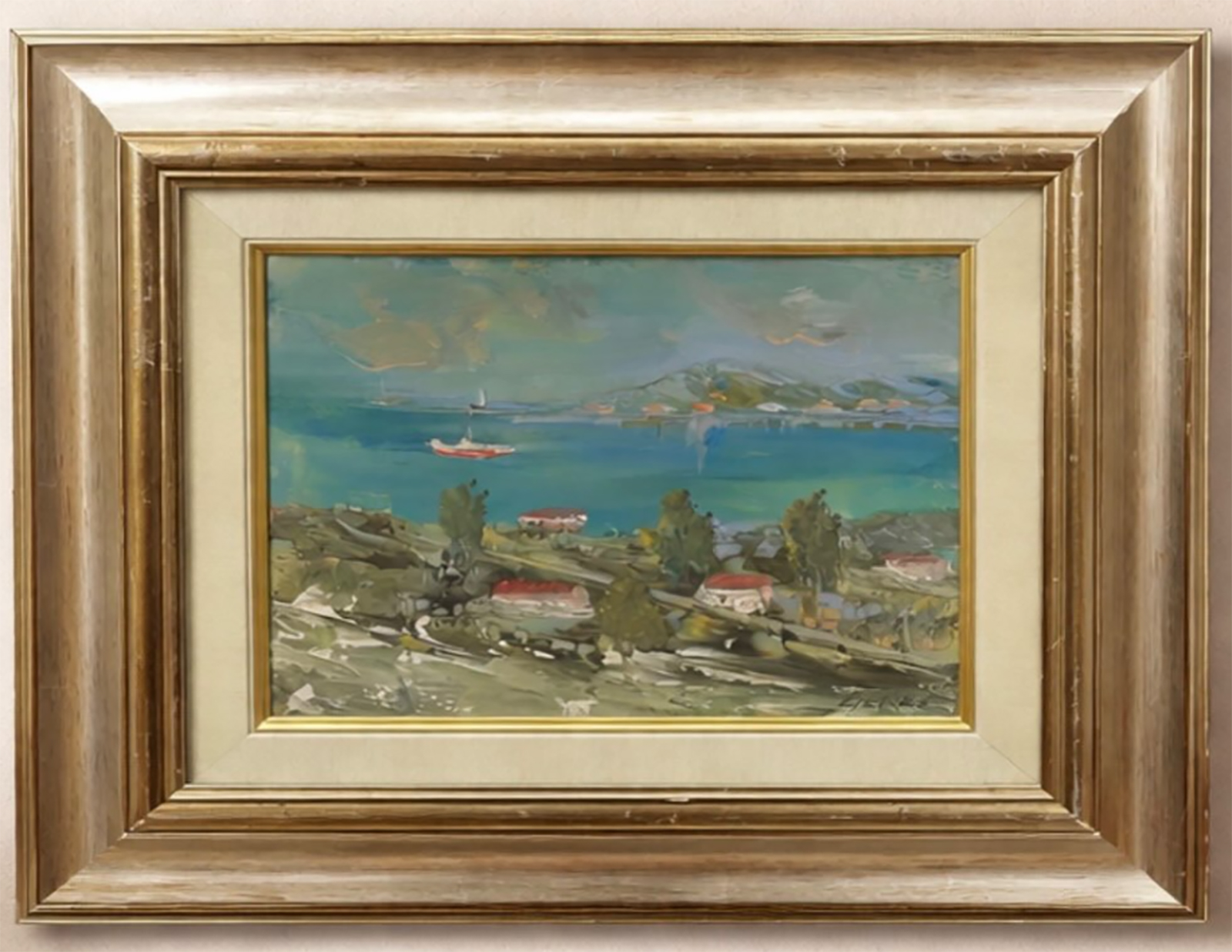
Seascapes and coastal views, in particular, hold a significant place in the artist’s body of work. Works that have survived to the present day—often found in auction catalogs—include “Seascape,” coastal vistas, and compositions featuring the sea and boats. These paintings are characterized by expansive blue-green areas, white light, and rapid brushstrokes.
Trees also constitute a significant motif in Gerez’s art. The emergence of tree-like forms from within the paint flows in his early abstract works illustrates how the artist establishes a relationship between the abstract and the concrete.
The human figure moved to the center of the artist’s work, particularly after 2001. In these paintings—which he titled “Human Landscapes” (İnsan Manzaraları)—figures appear sometimes individually and at other times in groups. Animals and dolls may also appear alongside human figures within the same composition. Consequently, the artist’s later works reflect a conception of the figure that evokes psychological and social conditions rather than offering a realistic depiction of the human form.
While oil paint forms the foundation of Gerez’s technical repertoire, the artist has also experimented with various other materials and methods. Techniques such as thinning paint with thinner to create fluid, marbling-like effects on the surface, and—in later periods—combining abstract and figurative elements on the same canvas, demonstrate his experimental nature.
Collage-like effects are also evident in some of his works. A 2017 assessment notes that Gerez created such effects by pouring molten lead onto his paintings. This approach reveals that he does not shape the painted surface solely with a brush but also incorporates distinct physical interventions into his artistic language.
Color is one of the most powerful formal elements in Gerez’s work. Employing vibrant shades of blue, green, yellow, red, and white, the artist has explored the interplay of light and color, particularly in his depictions of nature and the sea.
Major Works and Series;
The fact that Habib Gerez himself stated he produced approximately 10,000 paintings makes it extremely difficult to catalog every single one of his works individually. Therefore, the list below should be evaluated based on distinct series within the artist's body of work and pieces currently documented in records.
• Seascape – One of the oil paintings addressing themes of the sea and coastline.
• Düşlerin Ardı (Beyond Dreams) – A work listed in auction records as an oil painting on canvas measuring 110 × 80 cm.
• Abstract Composition – Works reflecting the characteristics of his abstract period.
• Human Landscapes – A group of figurative-abstract works developed after 2001.
• Views of Galata and Istanbul – Paintings based on urban memory.
• Sea and Boat Compositions – A significant portion of the artist's landscape output.
• Tree and Nature Compositions – Works that stand out, particularly from the period of transition from abstraction to figuration.
• Figurative Compositions – Late-period works featuring combinations of human, animal, and doll figures.
Numerous works by Gerez—executed in oil on cardboard, hardboard, and canvas—appear in contemporary auction records. These records demonstrate that the artist worked extensively not only on large-scale canvases but also on smaller surfaces.
Solo Exhibitions;
Habib Gerez had an extensive exhibition history. References citing figures such as 120, 130, and ultimately 142 solo exhibitions across different periods indicate that the total count was updated over time. Reports published by Bianet and Şalom following his death highlight a total of 142 solo exhibitions, 33 of which were held abroad. Some of the solo exhibitions with dates and venues verifiable through online sources are as follows:
• 1988 – Association of People from Turkey (Türkiyeliler Derneği) – Bat-Yam, Israel
• 1989 – La Cimaise – Montpellier, France
• 1991 – Communauté Urbaine – Strasbourg, France
• 1993 – Galerie Beith-Elie – Ashkelon, Israel
• 1993 – Yehud Municipality – Tel Aviv, Israel
• 1994 – City of Cugnaux / Town Hall – Toulouse, France
• 1995 – L’Espace République – Montpellier, France
• 1996 – Morez Municipality / Town Hall – Morez, France
• 1996 – Académie des Jeux Floraux Association / Le Cercle d’Art Contemporain – Toulouse, France
• 1998 – À La Station – Les Rousses, Haut-Jura, France
• 2000 – Caveaux des Artistes – Saint-Claude, France
• 2000 – Caisse d’Epargne – Nancy, France
• 2001 – City of Ronchin – Ronchin, France
• 2002 – Pavillon Saint-Sauveur – Lille, France
This list represents only a small fraction of the artist's solo exhibitions. The exhibitions held in France and Israel, particularly during the 1990s, are significant in demonstrating the extent of Gerez’s engagement with the international art community.
In Turkey, Gerez’s exhibitions have been concentrated primarily in art venues within the Beyoğlu, Galata, Tünel, and Nişantaşı districts of Istanbul.
Notable Group Exhibitions Participated In;
It is evident that Gerez has participated in numerous group exhibitions throughout his long artistic career. Some examples that can be verified through online exhibition records include:
• 1996 – Kuydaş Art Gallery – Kuşadası / Denizli
• 1996 – İş Bank Art Gallery – Kavaklıdere, Ankara
• 1996 – Ürün Art Gallery – Caddebostan, Istanbul
• 1996 – Association for the Protection of the Poor – Beyoğlu, Istanbul
• 1997 – Tekel Art Gallery – Unkapanı, Istanbul
• 1997 – İletişim Art Gallery – Alsancak, Izmir
• 1998 – Tarabya Art Gallery – Istanbul
• 1998 – Gözlem Art Gallery – Nişantaşı, Istanbul
• 1998 – Neve Shalom Cultural Center – Beyoğlu, Istanbul
• 1998 – Barometre Art Gallery – Taksim, Istanbul
• 1998 – Ariyel Art Gallery – Nişantaşı, Istanbul
• 2000 – Atatürk Cultural Center – Taksim, Istanbul
• 2001 – Association of Friends of Culture – Selimiye, Istanbul
• 2001 – Şule Art House – Beyoğlu, Istanbul
• 2001 – Association for the Protection of the Poor – Beyoğlu, Istanbul
• 2002 – Gerez Art House – Beyoğlu, Istanbul
• 2002 – Ziraat Bank Gallery – Galata, Istanbul
• 2003 – Çakınberk Art Gallery – Balıkesir
This exhibition history demonstrates that Gerez was an active participant in the circulation of art among private galleries, associations, and cultural institutions in Istanbul, particularly during the 1990s and early 2000s.
In subsequent years, the artist's works continued to be featured in group exhibitions. For instance, Gerez’s works were exhibited alongside those of artists such as Selçuk Uçku, Aylin Güzelbeyoğlu, Solmaz Aksoy, Hikmet Çetinkaya, and Hüseyin Macar at the Galata Rotary Club exhibition held as part of Galatart 9.
Plans were also made for Gerez to participate with his works in the exhibition titled “Sephardic: In the Footsteps of a Multicultural Heritage,” which opened in Seville in 2022—shortly before his passing. That exhibition brought together over 70 works by 33 Turkish Sephardic artists.
In 2023, Gerez’s works were once again presented to art lovers as part of the Galatart’11 Exhibition of Painters from Galata; the exhibition featured 24 of the artist’s pieces.
Awards;
Habib Gerez has won numerous awards in the fields of painting and poetry. Sources cite a total of 63 awards. These accolades are not limited to painting but also encompass poetry competitions.
Notable awards in the field of poetry include:
• 1979 – Accademia Internazionale di San Marco Poetry Award
• 1980 – Centro d’Arte La Prora / Movimento Artistico Nazionale “Plurismo” Poetry Award
• 1985 – Accademia Internazionale di San Marco Poetry Award
• 1993 – Accademia Internazionale di San Marco Poetry Award.
One of the most significant international awards of his artistic career is the European Academy Grand Prize, presented in Italy in 1998. Awarded annually to only one individual by the European Academy, this prize was bestowed upon Gerez in recognition of his artistic and cultural activities spanning nearly half a century. The award ceremony took place in Italy on June 28, 1998.
Gerez also became an honorary member of six academies abroad and served as the Turkish representative for the European Academy, an institution affiliated with the Council of Europe.
Collections and Museums Housing His Works;
Habib Gerez’s works are held in various museums and collections in Turkey and abroad, including:
• Selçuk Yaşar Museum – Turkey
• Edirne Contemporary Art Museum – Turkey
• Loukine Arsonval Museum – France
• Troyes Museum of Fine Arts – France
• Herstal Museum – Belgium
• Judah Magnes Museum – USA
• Jewish Art Museum – Israel
• Ben-Ari Museum – Israel. The artist’s home and studio in Galata constituted a significant art archive in their own right. Here, Gerez amassed not only his paintings but also his books, photographs, newspaper clippings, awards, letters, and documents relating to his artistic career. Consequently, the Habib Gerez Art House serves as a repository of cultural memory that transcends the artist's individual body of work.
Poet and Writer Habib Gerez;
To view Habib Gerez solely as a painter would be to overlook a significant aspect of his identity.
Gerez began writing poetry at a young age and regarded it as being just as important as painting throughout his life. Themes such as the joy of living, nature, peace, affection, love, childhood, time, and death featured prominently in his poems. Some of his works have been translated into English, French, Italian, and Russian. Major poetry collections include:
• 1952 – Gönülden Damlalar (Droplets from the Heart)
• 1954 – Renklerin Akımı (The Flow of Colors)
• 1955 – Savrulan Zaman (Scattered Time)
• 1956 – Meyhaneden Çıkan Kral (The King Leaving the Tavern)
• 1960 – Acılı Bitimler (Painful Endings)
• 1963 – Seni Yaşamak (Living You)
• 1965 – Dar Açılar (Narrow Angles)
• 1966 – Ölü Nokta (Dead Point)
• 1967 – Arayış İçinde (In Search)
• 1969 – Büyük Güzel (The Great Beauty)
• 1970 – Başını Alıp Giden Dünya (The World That Went Its Own Way)
• 1983 – Yaşama Sevinci (Joy of Living)
• 1986 – Gökyüzüne Gülen Güller (Roses Smiling at the Sky)
• 1998 – Rüzgâra Söylenenler (Words Spoken to the Wind)
• 1998 – Yaşamın Tadı Tuzu Sanat (Art: The Spice of Life)
• 2000 – Özlem Yorgunu (Weary of Longing)
• 2005 – Geçmişte Kalanlar (Remnants of the Past)
• 2007 – Aşk ve İstanbul / Bir Şarkıdır Dudaklarımızda (Love and Istanbul / A Song on Our Lips)
• 2010 – Geçmişin Gözyaşları (Tears of the Past)
• 2011 – Soluksuz Yalnızlıklar (Breathless Solitudes)
• 2012 – Prangalı Özlemler (Shackled Longings)
• 2015 – Ertelenmiş Suskular (Postponed Silences)
• 2016 – Sonsuz Şimdiler Arasında (Amidst Infinite 'Nows')
The connection Gerez establishes between poetry and painting is one of the most characteristic features of his art. For him, color and words are not two disconnected forms of expression, but rather two different manifestations of the same sensibility.
Habib Gerez and Galata;
When evaluating Habib Gerez’s position in Turkish art, Galata must be addressed as a distinct and significant topic.
For a vast portion of his life, Galata served as Gerez’s home, studio, and social sphere. Tünel, Galip Dede Street, Yüksek Kaldırım, Asmalımescit, and the area surrounding the Galata Tower became integral parts of the artist’s daily life.
Consequently, Gerez’s paintings of Galata are not merely depictions of architectural vistas; they also constitute a form of urban memory.
The artist’s devotion to Galata became inextricably linked to his artistic career. It is no coincidence that a commemorative article published in *Şalom* described Gerez as a "lover of Galata."
In this respect, Gerez stands out within the tradition of Istanbul-themed painting as an artist who approached a specific neighborhood of the city not merely as a visual subject, but as a component of his own personal identity.
His Position in the History of Turkish Painting;
Habib Gerez should be viewed not as a painter bound to the manifesto of a specific art group or an academic school, but rather as an independent artist who cultivated his own personal artistic system over many years.
His significance can be summarized in three key points.
The first is the unique relationship he established between the abstract and the concrete. His approach to painting—which began in the 1960s with experiments involving abstract surfaces—evolved into realistic nature and figure studies in the 1970s, progressed to a synthesis of the abstract and the concrete after 1985, and culminated in his "Human Landscapes" (*İnsan Manzaraları*) series after 2001. Thus, Gerez’s art follows a trajectory of development too broad to be defined by a single stylistic label.
The second is the contribution he made to the visual memory of Istanbul, and Galata in particular. He approached Galata not merely as a subject for landscape painting, but as a space of personal and collective memory.
A third aspect is his embodiment of the identities of painter, poet, writer, and man of culture all in one person. Gerez’s hundreds of articles, poetry collections, writings on art, exhibitions, personal archive, and art house in Galata demonstrate that his artistic activity was not confined to the canvas alone.
Furthermore, Gerez holds a significant place in the cultural life of the Turkish Jewish community. His advocacy for the correct and effective use of Turkish, his work regarding the cultural memory of the Turkish Jewish community, and his contributions to the preservation of Judeo-Spanish (Ladino) culture earn him a special position within Turkey’s multicultural art history.
For this reason, it is insufficient to label Habib Gerez merely as a "Turkish Jewish painter." He was a multifaceted artist who came of age in Republican-era Istanbul, wrote poetry in Turkish, placed Istanbul and Galata at the heart of his art, held international exhibitions, and navigated diverse cultural spheres throughout his artistic career.
General Assessment;
Habib Gerez (June 14, 1926 – May 25, 2022) was a distinctive artist who, over a creative career spanning nearly seventy years, simultaneously pursued the fields of painting, poetry, writing, and culture.
His artistic journey evolved from the experimental, *ebru* (marbling)-influenced paint flows of the 1960s to the realistic works of the 1970s; from a personal technique blending the abstract and the concrete after 1985 to the figurative world he termed "Human Landscapes" (*İnsan Manzaraları*) after 2001.
The most notable characteristic of this long developmental process is that the artist never completely abandoned any of his previous periods. The paint flows characteristic of his abstract period persisted in his later realistic works, while realistic figures found their way back into his late-period abstract compositions.
The fact that Gerez—who stated he produced approximately 10,000 paintings—held 142 solo exhibitions (33 of them abroad) and received 63 awards in the fields of painting and poetry demonstrates the sheer scale of his productivity.
However, Gerez’s significance in art history cannot be explained solely by the volume of his output.
His true importance lies in how he brought together Istanbul, Galata, the sea, nature, humanity, memory, and the joy of living within his own personal world of color.
His painting and poetry were never separated; words and colors served as two distinct modes of expression for the same artistic sensibility. His home and studio in Galata became the physical embodiment of this unity.
For this reason, Habib Gerez holds a unique place in the history of Turkish painting, distinguished by his identity as an independent artist, his synthesis of the abstract and the concrete, his depictions of Istanbul and Galata, his multicultural identity, the interplay between his poetry and painting, and his extraordinary productivity.
Perhaps the most defining legacy of his art is his refusal to separate art from life. For Gerez, painting was not merely a profession, poetry not merely a literary pursuit, and Galata not merely a neighborhood; rather, they were all integral parts of a long life, united within a single cultural memory.
-

- Habib Gerez

-

- Habib Gerez

-

- Habib Gerez

-

- Habib Gerez

-

- Habib Gerez

-

- Habib Gerez

-
- Habib Gerez

-

- Habib Gerez

-

- Habib Gerez

-

- Habib Gerez

-

- Habib Gerez

-

- Habib Gerez
-

- Habib Gerez

-

- Habib Gerez

-

- Habib Gerez

-

- Habib Gerez

-

- Habib Gerez
-

- Habib Gerez

-

- Habib Gerez

-

- Habib Gerez

-

- Habib Gerez
