


Who was Cevat Erkul? (1897 Thessaloniki – 1981)
Cevat Erkul was born in 1897 in Thessaloniki, which was then part of the Ottoman Empire. His father was a high-ranking member of the judiciary. His family’s educated background and involvement in state affairs ensured that Erkul grew up in a strong academic and cultural environment.
After completing his primary education in Thessaloniki, he moved to Istanbul with his family during the Balkan Wars. He received his education at the Saint Joseph French school in Istanbul and then served as a reserve officer during World War I.
After the war, he studied at the Istanbul University Faculty of Law and began his career as a judge. However, his passion for painting, which had lasted since childhood, led him to art education, and he entered the Academy of Fine Arts to begin his academic painting studies.
At the Academy, he particularly worked in Hikmet Onat’s studio and was influenced by Onat’s disciplined observation and nature-based approach to painting, a significant figure in the Turkish painting tradition.
Development of His Artistic Life;
Cevat Erkul’s artistic life began in his childhood years. He himself recounted that he constantly drew pictures during lessons in school and therefore frequently received warnings from his teachers. This early interest, combined with academic discipline in later years, transformed into a strong artistic output.
His artistic life particularly highlighted:
• Nature observation
• Cityscapes
• Landscape studies
• Academic figure and composition approach.
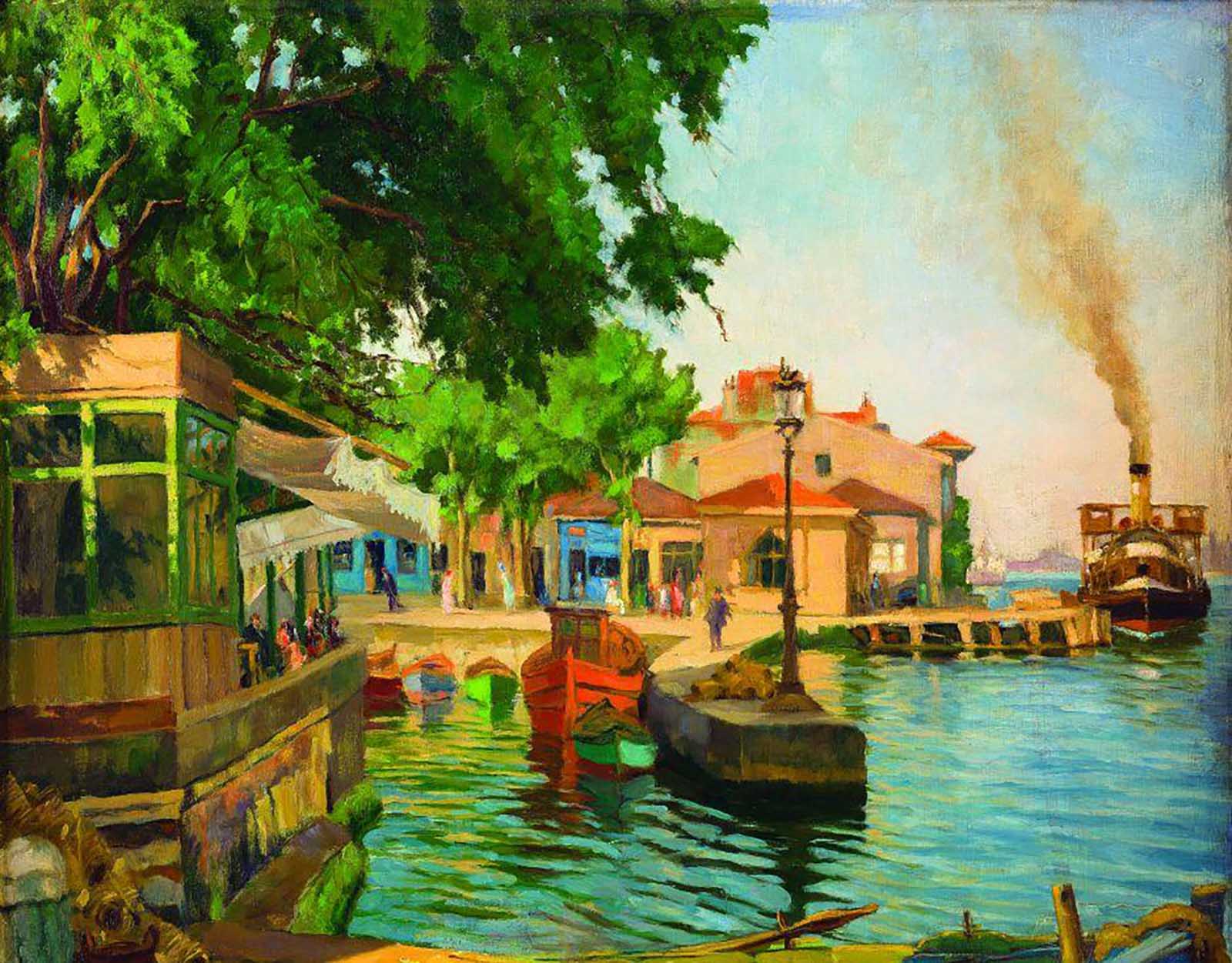
One of his well-known works is his 1957 painting “Frog Creek Landscape,” which is an important example of his approach to cityscapes.
It is also known that his production continued into the 1970s, and he produced oil paintings in different periods.
Artistic Perspective;
Cevat Erkul's artistic approach can be evaluated on the following basic axes:
Academic Nature Observation
He adopted the approach of painting by directly observing nature, influenced by his academic education and Hikmet Onat.
Realist – Naturalistic Tendency
In Erkul's works, nature and urban fabric are depicted in a realistic and balanced composition.
Classical Education – Transition to the Modern Period
He serves as a bridge between the art understanding of the late Ottoman period and the early Republican period.
Professional Identity: Balance Between Law and Art;
One of the striking aspects of Erkul's career is his ability to combine his legal profession with artistic production. Receiving academic painting training while serving as a judge brings him closer to the "intellectual artist" type of the period.
This situation is one of the important examples reflecting the profile of the early Republican intellectual artist.
Exhibitions and Artistic Activities;
While a detailed chronological list of Cevat Erkul's exhibition life is limited:
• Active art production within the academy
• Circulation of his works in the art market
• Inclusion in collection and auction records
shows that he was a prolific artist.
Known records of artwork sales and exhibitions indicate an active art practice extending from the 1950s to the 1970s.
Cevat Erkul's Place and Importance in Turkish Painting;
Cevat Erkul is important in the history of Turkish painting in the following aspects:
One of the Representatives of the Academic Generation
He can be counted among the artists who played a role in carrying the pre-Republican academic art tradition into the Republican period.
Profile of a Legal-Art Intellectual
He is one of the representatives of the type of artist who continued his art production together with his intellectual professional life.
Urban Landscape and Observation Tradition
His landscape approach to Istanbul and its surroundings is important in terms of depicting local geography in Turkish painting.
Historical Evaluation;
From an art historical perspective, Erkul can be evaluated as:
• An artist who continued the tradition of academic realism
• An artist who centered on observation of nature and the city
• An artist who reflected the early Republican art atmosphere.
His production is important for understanding the transitional generations in the modernization process of Turkish painting. Although Cevat Erkul was professionally in the field of law, he received his art education at an academic level and kept painting production at the center of his life. In Turkish painting, he is an important figure who can be evaluated under the following headings:
• Academic education tradition
• Nature observation
• Urban landscape
• Intellectual artist identity.
-

- Cevat Erkul

-

- Cevat Erkul

-
- Cevat Erkul

-

- Cevat Erkul

-

- Cevat Erkul

-
- Cevat Erkul
-

- Cevat Erkul

-

- Cevat Erkul

-

- Cevat Erkul

-

- Cevat Erkul

-

- Cevat Erkul

-

- Cevat Erkul

-

- Cevat Erkul

-

- Cevat Erkul

-

- Cevat Erkul

-

- Cevat Erkul

-

- Cevat Erkul

-

- Cevat Erkul

-

- Cevat Erkul

-

- Cevat Erkul

-

- Cevat Erkul

-

- Cevat Erkul

-

- Cevat Erkul

-

- Cevat Erkul
