


Who is Melis Balaban? (2000-Konya)
She was born in Ereğli, Konya in 2000. In 2020, she was accepted to the Painting and Art Education Department of the Faculty of Education at Niğde Ömer Halisdemir University. She graduated in 2024. She is currently continuing her education in the Painting Department of the Fine Arts Institute at Hacettepe University, as part of her Master’s program. 2021 Pandemic-Changed World Painting Competition 2nd Achievement Award, Niğde
2022 “Visual Narratives” Fine Arts Education Department End-of-Term Exhibition, Niğde
2024 “Bigem” March 8th International Women’s Day Group Exhibition, Niğde
2024 Fine Arts Education Department “Graduation Exhibition”, Niğde
2025 “We Printed 25” exhibition, Tosca Art Design, Ankara
2026 “Ser’s Open”, Yavrukuş Art Gallery, Ankara
2026 “April Selection; Common Ground”, MU Art Space, İzmir
2026 DenizBank III. IAAF İzmir Art Fair, İzmir
2026 “BAS NO:4”, Belm’art Space, Ankara
2026 “Look at Me One More Time”, Art in Town by Hilltown, İzmir
Art Perspective;
My works reflect the contemporary human being It metaphorically depicts the state of sleep. By reflecting the social and societal phenomena I observe in my work, I try to create a narrative related to the experiences of contemporary people. The constant change imposed by a fast-paced life creates a deep existential loneliness and a state of fragmentation in the individual. In this context, my works focus on the state of sleep and the fragmented subject experience. The themes I address in my paintings come to life in an intertwined atmosphere where the boundaries between dream and reality become blurred. In this atmosphere, the body emerges as an image that has lost its integrity and is reconstructed in fragments. This fragmentation is a reflection of the perceptual and existential fractures that the individual is constantly exposed to in contemporary life. The figures move away from a clear and fixed representation; through deformations, erasures, and transitions on the surface, they appear as images that seep from memory and cannot be fully grasped. In this process, the state of sleep is addressed through memory and the body image, while elements located in the depths of memory but which cannot be remembered or understood become visible as distortions and differentiations on the canvas surface. My work treats the body not merely as a physical entity, but as a fragile, permeable, and blurred space bearing the traces of consciousness and memory. The resulting visual language presents a layered narrative of the subject’s fragmentation and disintegration, on a plane where the boundaries between dream and reality blur.
-
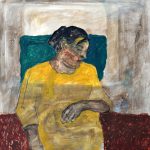
- Melis Balaban

-

- Melis Balaban

-

- Melis Balaban

-

- Melis Balaban

-

- Melis Balaban

-

- Melis Balaban

-

- Melis Balaban

-

- Melis Balaban

-

- Melis Balaban

-

- Melis Balaban

-
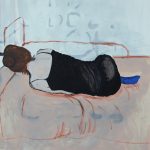
- Melis Balaban

-

- Melis Balaban

-

- Melis Balaban

-

- Melis Balaban

-

- Melis Balaban

-

- Melis Balaban

-

- Melis Balaban

-

- Melis Balaban

-

- Melis Balaban

-

- Melis Balaban

-

- Melis Balaban

-

- Melis Balaban
